
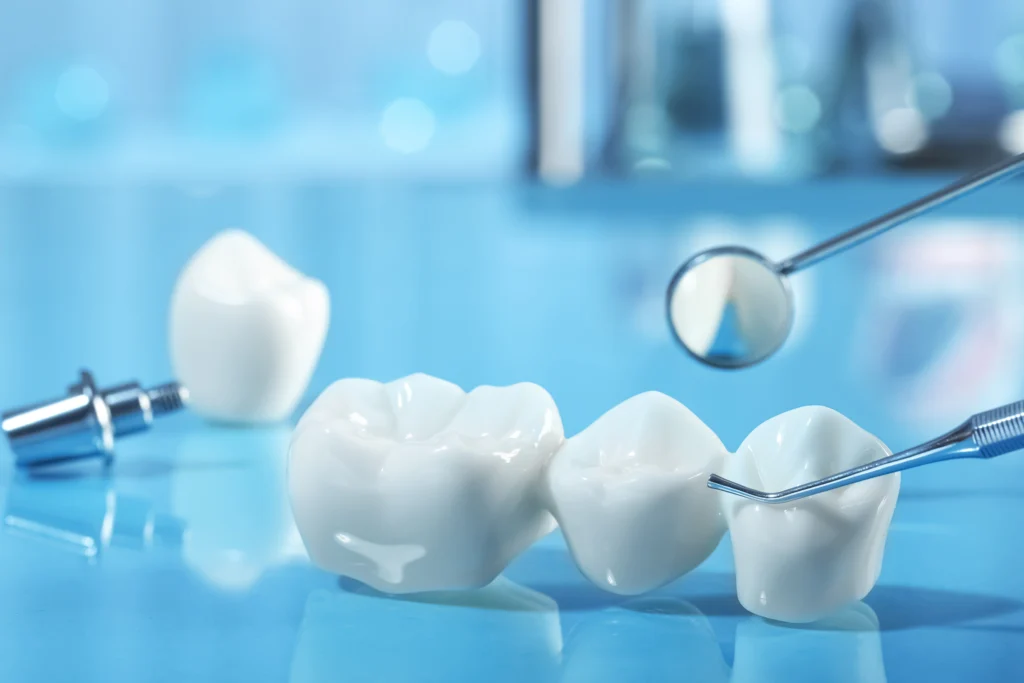
When you’re exploring restorative options for your smile, it’s important to understand how dental crowns and bridges in Hartland differ – not just in function, but in cost, process, materials, and long-term value. In this guide, we’ll explain the differences between a dental crown and a dental bridge, offer insights on costs, and offer tips on the benefits of each restoration.
What Is a Dental Crown & How Is It Created & Placed?
A dental crown is a custom “cap” placed over an existing tooth that’s been damaged, decayed, or structurally weakened. It restores the tooth’s shape, strength, and appearance.
The Dental Crown Procedure
- After confirming that you’d benefit from a dental crown, our dentist will prepare your tooth by removing decay and shaping it.
- Impressions or digital scans are made.
- A customized same-day crown is created and checked to ensure an ideal fit before being cemented in place.
Typical crowns last 10–15 years with good care.
What Is a Dental Bridge & How Is It Created & Placed?
A dental bridge is used when one or more teeth are missing. A bridge “bridges” the gap by anchoring replacement (pontic) tooth/teeth to crowns on adjacent abutment teeth or implants.
The Dental Bridge Procedure
- The teeth adjacent to the missing tooth are prepared (shaved down) for crowns or attachments.
- Impressions or scans capture the span.
- A customized same-day bridge is created and checked to ensure a good fit before being cemented in place.
- You’ll need special flossing techniques to clean underneath the pontic.
Bridges help maintain tooth alignment and restore chewing, speech, and function.
Cost Comparison: Crown vs Bridge
| Option | Typical U.S. / Regional Cost Range* | Key Cost Drivers |
| Dental Crown | $1000 – $2,500 (varies by material & complexity) | Material (porcelain, zirconia, metal), lab fees, tooth prep, existing damage, or root canal required |
| Dental Bridge (3-unit traditional) | Around $2,000 – $5,000 | Number of units (pontics), supporting teeth condition, materials, and complexity |
*The figures above are estimates. Your family dentist in Hartland will provide a customized quote that reflects your oral health, materials, insurance, and lab costs.
Pros & Cons
| Feature | Crown | Bridge |
| Scope | Single damaged tooth | Replaces one or more missing teeth |
| Tooth preparation | Only the target tooth is shaped | At least two adjacent teeth must be prepared |
| Longevity | 10–15+ years | Often 5–15 years, depending on hygiene and other factors |
| Impact on neighboring teeth | Minimal | Alters adjacent teeth, possibly increasing stress or decay risk |
| Hygiene | Brush/floss normally | Must clean beneath pontic – floss threaders, water picks help |
Choosing What’s Right for You
- If you have a tooth that’s still present but damaged, a dental crown treatment often makes sense.
- If you’re missing one or more teeth, dental bridge treatment may be ideal, provided neighboring teeth are healthy enough to support it.
- As a trusted dentist in Hartland, we will assess your gum health, bone density, and the condition of adjacent teeth to recommend the optimal path.
- Insurance, material choice, and aesthetics also play into decision-making. Some plans cover a portion of both crowns and bridges as major restorations.
Patient Testimonial
“Thank you to all for dealing with my broken tooth and crown so quickly and professionally. I feel very grateful to have found Cloud 9!”
– Stacy S.
Tips to Save & Maximize Value
- Ask about in-network labs or dental plans to reduce lab fees.
- Choose durable materials (e.g., zirconia or porcelain-fused-to-metal) for longevity.
- Maintain excellent oral hygiene – bridges rely on healthy supporting teeth.
- Explore payment plans or dental financing with your Hartland dentist.
- Combine restorative work (crowns, bridges) when possible to reduce repeated lab fees.
If you’re considering restorative options – same-day dental crown services or same-day dental bridge services – we’d love to help guide you. Call Cloud 9 Dentistry today at (262) 361-1898 to take the first step toward a stronger and more beautiful smile!
FAQs
1. What affects the cost of a dental crown?
The material (porcelain, zirconia, or metal), complexity of preparation, lab work, need for root canals or build-up, and insurance coverage all influence the final cost of a dental crown procedure. If you have questions, call us at (262) 361-1898 today to learn more!
2. How many teeth can a dental bridge replace?
A bridge can replace one or multiple missing teeth, but the complexity and cost increase with the addition of more pontics. Your dental bridge procedure will be planned based on span, support, and the condition of the surrounding teeth.
3. Can a crown be replaced with a bridge later?
Yes, if adjacent teeth become involved or if a tooth is lost, your dental crown treatment might evolve into a dental bridge treatment, assuming supports are healthy and suitable for anchoring.
4. How long do crowns and bridges last?
Well-maintained dental crowns can last 10–15 years or more, while bridges typically last 5–15 years, depending on oral hygiene and the material used.
5. Will my insurance cover crowns and bridges?
Most dental plans treat crowns and bridges as “major” procedures and may cover 50% or more, depending on your plan and whether the restoration is deemed medically necessary.
